
Author
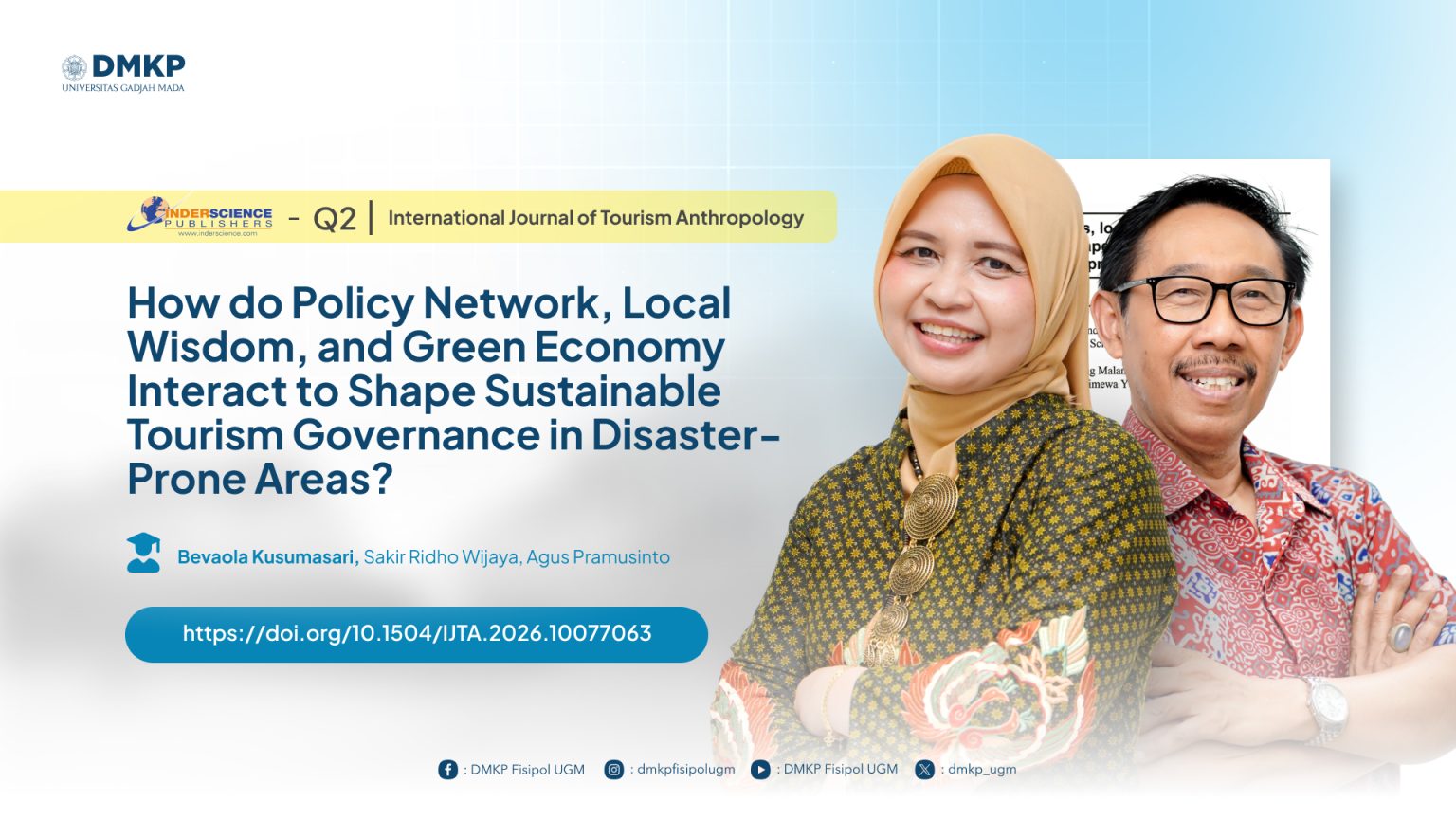
Bevaola Kusumasari, Sakir Ridho Wijaya, Agus Pramusinto
Abstract
Tourism development in disaster-prone zones is long overdue and remains a pressing challenge in the Global South, where institutionally self-destructive governance often deters community engagement. Although West Nusa Tenggara (NTB) has strong cultural and ecological appeal, environmental and governance issues can negatively affect tourism. This study secks to understand the role of the policy network, the role of community-based tourism (CBT), and the green economy in the re-governance of tourism in NTB, and to develop a community culture-oriented disaster resilience and sustainability model. This study employs semi-structured interviews, observations, and document analysis in four tourism communities and two governments. The findings indicate formal policy networks are hierarchical and elitist, excluding the local actors and communities at the base of the networks from decision-making. The governance structures, ethics, and self-regulating and redistributive mechanisms of CBT, are important as well as the grassroots or bottom-up innovations of local community structures encouraged by the green economy. The study proposes a policy networks, community, sovereignity and environmentally based practice integrative framework for transferable global south contexts.
Keywords
Sustainable Tourism; Policy Collaboration; Local Wisdom; Environmental Governance; Green Economy; Disaster-Prone Areas; Community-Based Tourism; Indonesia.
Access link:
https://doi.org/10.1504/IJTA.2026.10077063